
Our Shareholders and Board
The Gladstone Ports Corporation (GPC) is a Government Owned Corporation (GOC). GPC commits to meeting the expectations of shareholding Ministers (SHM), namely the:
- Minister for Finance, Trade, Employment and Training; and
- Minister for Transport and Main Roads.
GPC applies governance frameworks to ensure that our actions are aligned with government and stakeholder priorities and provides the leadership GPC requires to:
- attain our vision
- undertake our purpose
- uphold our values and behaviours
- efficiently and effectively achieve our strategic objectives and actions.
GPC is required to comply with various statutes; however, the following set the core legislative framework in which the Corporation operates:
- Government Owned Corporations Act 1993 (GOC Act) and Regulations;
- Transport Infrastructure Act 1994 (QLD) and Regulations;
- Financial Accountability Act 2009 (QLD) and Regulations; and
- Corporations Act 2001 (Cth).
In line with the requirements of the Government Owned Corporations Act 1993 (Qld), shareholding Ministers are advised in a timely manner of all issues likely to have a significant financial, operational, employee, community or environmental impact. GPC also regularly assesses the key information requirements of its stakeholders.
GPC is committed to adopting leading practices in sustaining its economic, financial, social and environmentally focussed operations. Our governance framework is parented by the Queensland Government’s overarching position as principal stakeholders and the GOC Act. The framework connects the culture, structures and processes for effective decision making and accountability and utilises three interacting components of Corporate Governance Methodology, Corporate Governance Principles and Corporate Governance Outcomes.
GPC is committed to ensuring that our shareholding Ministers are continually and appropriately informed of our performance and activities. Communication is undertaken through several forums. These include:
- Statement of Corporate Intent
- Corporate Plan
- Quarterly Reports
- Annual Report
- Briefings
The Statement of Corporate Intent and Corporate Plan provide a transparent set of agreed performance criteria and strategic objectives on which to report to shareholding Ministers and their representatives via the Quarterly Report. The Statement of Corporate Intent (with commercially sensitive information redacted) is tabled in Parliament and published on this website.
An Annual Report containing those matters outlined in section 120 of the Government Owned Corporations Act 1993 (Qld) is also tabled in Parliament and published on this website. Briefings to shareholding Ministers and their departments are conducted on a regular basis for the purpose of disclosing business activities and performance against agreed targets.
Our Board of Directors are appointed by the Governor in Council, pursuant to the Government Owned Corporations Act 1993 (GOC Act). The Board of GPC assumes overall responsibility for corporate governance practices within GPC and monitors the performance of the Corporation, its management and employees.
The Board, in conjunction with the Chief Executive Officer, establish and implement GPC’s strategic pillars of success; economic, financial and social impact, operational excellence and our values and behaviours. These are outlined in our Strategy 2030. Ongoing government, customer, community and employee consultation assist the Board to enact the corporate objectives defined in this strategy.
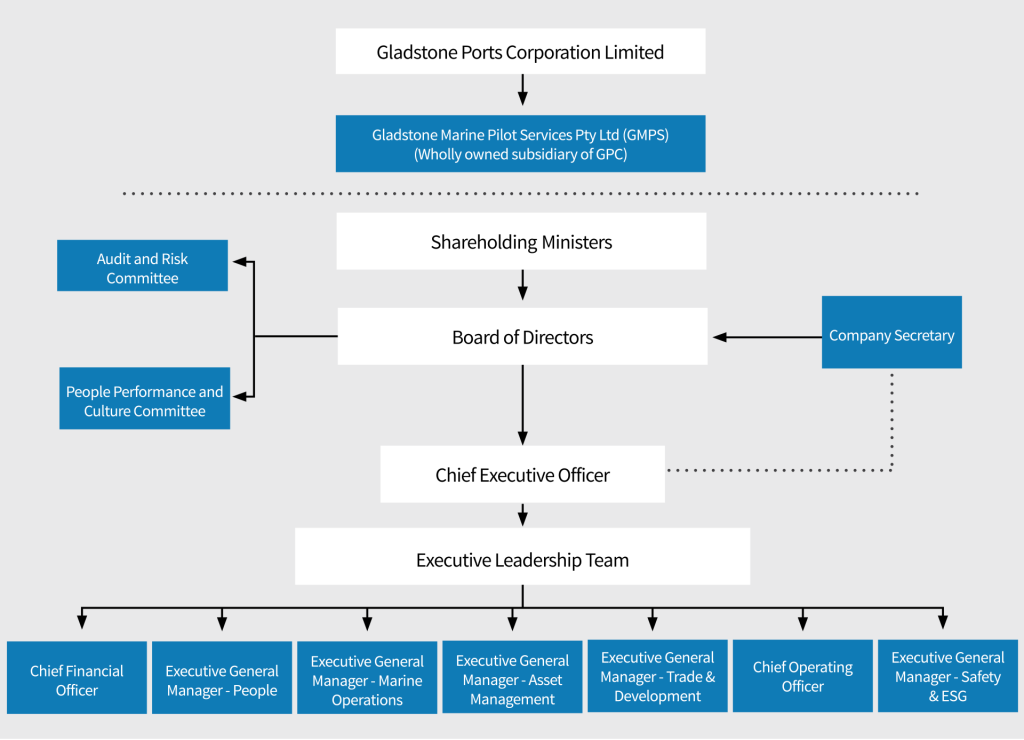
A structure that adds value
Gladstone Marine Pilots Services (GMPS) has the same Directors as GPC. All Directors are non-executive Directors. GPC is committed to ensuring that all new members of the Board receive an effective induction to their Board and Committee responsibilities as well as an overview of our structure, operations, policies and processes.
Role of the Board
Our Board assumes overall responsibility for corporate governance practices within GPC and monitors the performance of the Corporation, its management and employees. The Board, in conjunction with the Chief Executive Officer (CEO), establish and implement our operational, financial and strategic direction as outlined in our one-year (Statement of Corporate Intent), five-year (Corporate Plan) and long-term (50-year Strategic Plan) plans. Ongoing government, customer, community and employee consultation assist the Board to enact the corporate objectives defined in these plan.
Board committees
The Board may delegate its powers to a committee of Directors. GPC has two committees. The People Performance and Culture Committee (PPCC) and the Audit and Risk Committee (ARC). One Director on each committee is appointed Committee Chairperson by the Board.
Management personnel attend these meetings as required. GPC’s external and internal Auditor attend the ARC meetings.
View the Audit and Risk Committee (ARC) Charter
View the People Performance and Culture (PPC) Charter
Act ethically and responsibly
GPC’s ethical standards such as the Code of Conduct, Fraud and Corruption Prevention Policy, and Risk Management Policy, and the means by which we implement them, form part of the induction for all new Board members and employees. Updates are provided as new policy developments occur and as part of our CEO’s annual business update sessions.
You can view our policies on our Release of Information Publication Scheme page.
Code of Conduct
A Code of Conduct has been developed and formally adopted by the Board. The code gives detailed advice on the responsibility and accountability of individuals for reporting and investigating reports of unethical practices. It also provides comprehensive examples to illustrate application of the code. Employees are reminded of their obligations under the code during annual business update sessions presented by the CEO. Our code reflects the requirements of the Public Sector Ethics Act 1994.
Fraud and Corruption Prevention Policy
Fraud and Corruption Prevention applies to all Directors and our employees. A policy was developed to assist management and employees in the discharge of their responsibilities by setting out the procedures for managing fraud and corruption.
All incidences of theft and related activity are reported to the ARC on a regular basis for consideration of fraud control initiatives. Employees are also reminded of their obligations under this policy at the annual business update sessions.
Whistleblowers
All suspected and actual misconduct and reprisal action must be reported in accordance with the Public Interest Disclosure (PID) Procedure.
Under our Code of Conduct, all GPC employees are required to report any reasonably based suspicion of theft, fraud, assault, corruption and/or official misconduct to their manager, another appropriate officer of GPC, the PID Officer, through GPC’s confidential reporting hotline (1800 693 362), through the Crime and Corruption Commission or by phoning 1800 061 611.
While the GPC Hotline is intended primarily to be a service for employees, contractors and customers of GPC, the same reporting channel is available for the community to raise issues and concerns. No calls to the Hotline will be dismissed on the basis of their source. Find more information on GPC’s whistleblower program here.
GPC Hotline
Speak Up Integrity Hotline (Whistleblower) is a free call number, 1800 693 362, and is available Monday to Friday, 8.30am – 5pm.
Procedure on Public Interest Disclosure
GPC is committed to creating and maintaining a workplace where strong ethical standards are upheld and displayed through employee behaviour. This includes the reporting and management of misconduct and reprisal, legally referred to as PID. This Procedure has been developed to encourage the reporting of PIDs, provide transparent and accessible reporting processes, and protect employees who make a PID.
All PIDs and related activity are reported to the ARC on a regular basis for consideration. Employees are also reminded of their obligations under this Procedure at the annual business update sessions.
Public Interest Disclosure Procedure
Recognising and managing risk
Our Board retains ultimate responsibility for risk management and for determining the appropriate level of risk that the Board is willing to accept in the conduct of our business activities. The CEO provides the interface between the business units and the Board. Overall, the CEO has the ultimate responsibility for maintaining a Board-endorsed, robust corporate risk management system within GPC that — through transparency in reporting — reflects the true state of business risk exposure.
GPC is committed to:
- behaving as a responsible corporate citizen, protecting employees, customers, contractors and their property, as well as the community and the broader environment from unnecessary injury, loss or damage
- achieving our business objectives by minimising the impact of risks we can meaningfully and realistically control which would otherwise significantly affect our assets and earnings
- finding the right balance between the cost of control and the risks we are willing to accept as the legitimate grounds for earning reward.
The principles behind this policy are based on AS/NZ 31000:2009 Risk Management — Principles and Guidelines, and Principle 7 of the Queensland Government’s Corporate Governance Guidelines for Government Owned Corporations — February 2009.
Records management
GPC is aware of its responsibilities under the Public Records Act 2002 which ensures that operational business needs, legal, evidential and accountability requirements are met, and stakeholder expectations are fulfilled.
Diversity and Equity Action Plan
GPC has established a Diversity, Equity, Inclusion and Belonging (DEIB) group, who have developed a Diversity and Equity Action Plan for our future. This approach aims to develop inclusion across our workforce through welcoming diverse views, experiences and backgrounds of employees into our plans, organisational initiatives, and decision-making.
This plan is underpinned by the Public Sector Act 2022.